Studying mining and geology in Afghanistan and graduating with a degree in business from Utah State University, Saboor Sahely planned to work for a major mining or oil company after graduation. One thing is for sure, he knew he never wanted anything to do with the restaurant business. You just never know where life will take you.
While attending Utah State, Saboor worked as a dishwasher at Sambo’s Restaurant in Logan. After hoping to land a job in the fields he had studied, things took a different turn. To make a long story short, he eventually bought the place where he had worked as a dishwasher. It became Angie’s Restaurant in Logan. That was 1983 and Angie’s Restaurant is still going strong with Saboor at the helm. As people say, “Angie’s is where the locals eat,” with good food and fast, courteous service. As the new owner, Saboor paid attention to all the details, which meant connecting with his customers. Saboor proved himself wrong—he should be in the restaurant business! His decision has resulted in a very successful business that has become a true gift to Cache Valley.
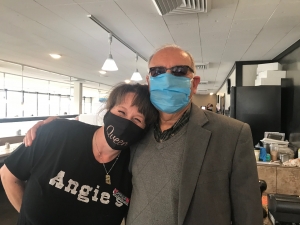
Saboor with Cherise Phillips, who’s been a server at Angie’s for twenty years.
Saboor shares his story of coming to the United States from his homeland of Afghanistan as a young college student. With determination and drive he arrived here with basically just the shirt on his back. The summer he arrived, he worked three jobs before school started and began moving forward in life, but it was not easy. He and his young family knew what it was like to ‘live on a shoestring.” Saboor has never forgotten what that was like. Through those growing pains, he learned compassion and appreciation for those who stood behind him—first and foremost, his wife Kristine and the ongoing support of the community. In turn he continues to give back in how he treats his customers, his employees, and by serving the community in many ways. Over the years, he has hired several second-generation employees to keep things running smoothly. Most importantly, his customers keep coming back, many of them now third-generation customers.
To contact Saboor Sahely for speaking engagements, email [email protected].
A spirited young woman who loves life, Hadjer Abir Bensaha has ambitious goals in mind. Coming to Utah from Algeria in 2016, she entered high school as a senior. With language and cultural barriers, she began attending a high school with little diversity. She has never been afraid to step out of her comfort zone. Not only did she graduate from Bear River High School in Garland, Utah, but she continued to keep up her studies and graduated at the top of her class from her school in Ksar Chellala Tiaret, Algeria, in that same year.
Continuing her education at Utah State University, Hadjer is majoring in International Business and Marketing with three minors in Leadership & Management, Entrepreneurship, and Technical Sales Management. Those aren’t all the skills she has in her toolbox; she also speaks Arabic, French, English, and is familiar with Spanish and Turkish.
Her father is a successful businessman and has traveled all over the world. After he had visited more than seventy different countries, he realized there were opportunities in the United States that he wanted his children to experience. Hadjer, with three of her brothers, are now living in Utah.
Currently, Hadjer works at Walmart and has great appreciation for her job and the people with whom she associates, including co-workers and customers. She’s the friendly smile you hope to have assist you while shopping. Some customers have showed appreciation by asking if they can give her hugs for her help– making her smile even bigger!
Hadjer’s father’s desire to see the world has rubbed off on her, and she hopes to travel the world by the time she’s fifty years old. For now, she’s trying new skills in camping and exploring nature, when and if she can find the time. She is always up for adventures, whether in education, travel, the outdoors, or getting to know more about the people with whom she associates. And for the rest of us, it’s an adventure for us to get to know her.
Hadjer is working hard to develop the skills and knowledge she’ll need to someday have her own business. And who knows– it might just be in Logan, Utah!
To contact Hadjer Benasah for a speaking engagement, email [email protected].
Rida Shoorbajee’s father originally came from the Ottoman Empire, which is in today’s country of Turkey. After the collapse of the Ottoman Empire, the Shoorbajee family settled in Syria, where Rida’s parents met. Eventually Rida’s father’s job led him to the United States. After losing that job in 2005, his new job offered him an opportunity to return his family to Syria.
Rida tells memories during those early years in Syria. He remembers it being a good life until the war began. He still carries the memories of war today. In 2013 the family moved back to the United States.
Rida recalls always having a problem with fitting in. In Syria he was looked at as being too American. In America, he was looked at being too Syrian. Those times proved quite difficult. He says he feels fortunate to have experienced both worlds as it gives him a better perspective of both sides. He has a better understanding of why Syrians misunderstand Americans and American misunderstand Syrians. He says,
It’s important that we talk more to each other, but that can be difficult. There is fear of saying or doing something that will be taken wrong. I and people in my situation find it best to stay quiet and go about life, which results in a disconnection.
He would like to see that change.
So how did Rida end up in Cache Valley? After a couple of failed attempts at going to college, Rida began working a job at an airport as a baggage handler. Being taken in by watching airplanes, Rida knew he wanted to become a pilot. He applied to Utah State University and was accepted. Having lived in fear of people often having biased opinions of people from the Middle East, his family had great concerns for him being so far away, but they did come to accept his decision. Rida says his experience in Cache Valley has been good for the most part.
He desires to have people see that all Muslims do believe in peace and are not terrorists. He says that he does not believe in violence, nor is it what the Quran teaches. He gives us an explanation of the true meaning of jihad and that it does not condone terrorism. He is hopeful that platforms such as this will help bring people together with an understanding that they can find common ground and hopefully help to tear down prejudicial walls.
To contact Rida Shoorbajee for a speaking engagement, email [email protected].
https://www.cachecommunityconnections.org/wp-content/uploads/ccc-logo.png00Nelda Aulthttps://www.cachecommunityconnections.org/wp-content/uploads/ccc-logo.pngNelda Ault2021-03-23 23:30:412021-03-25 10:21:09Connecting Neighbors: Rida Shoorbajee
Once you’ve had the opportunity to experience Aaron Timm’s sense of humor and wit, it leaves you with wanting to get to know more about her. It doesn’t take long to realize she’s a great conversationalist and quite smart. And it would be remiss to not also point out that she is a talented writer.
All this and you’d think she wouldn’t have any problems fitting in anywhere. Unfortunately, she has oftentimes been short-changed because she has challenges that set her apart from what people consider to be normal.
Aaron has albinism. Albinism is a group of inherited disorders where there is little or no production of the pigment melanin. Therefore, someone with albinism has no pigment in their skin, hair, or eyes. There are different degrees of albinism and Aaron says unfortunately, she got “the whole package,” which includes blindness.
However, Aaron is a woman who has found her way and is going to do all she can to keep things from getting in her way. She does credit her husband for helping her become more independent and motivated to take hold of the talents she has and developing them. He was the one who encouraged her to take all she is capable of doing and move out of her comfort zone. She has done that and seems to have “found herself” in many ways. She eventually went back to college (after a few bumps in the road) and accomplished getting two college degrees.
She also puts herself out into the community by taking part in writing workshops. She feels she is building “family” through what she can share in her writing. It not only helps her; it helps those who relate to her experiences. No, her blindness has not stopped her writing. She reads using a magnifier and she says she’s getting better at braille every day.
Aaron’s story provides a chance to see that there is a lot more to a person than what first impressions often skip over. As a person with the challenges she has faced, she offers much value to the Cache Valley community.
To contact Aaron Timm for a speaking engagement, email [email protected].
Darren Parry is the past Chairman of the Northwestern Band of the Shoshone Nation. Darren serves on the Board of Directors for the American West Heritage Center, the Utah State Museum Board, and serves on the Advisory Board of the Huntsman Cancer Institute. In 2017 he received the Esto Perpetua Award from the State of Idaho for preserving and promoting history in Idaho. He is the first in Utah to win this award.
Darren attend the University of Utah and Weber State University and received his Bachelor’s degree in Secondary Education, with an emphasis in History. He also teaches classes on Native American History at Utah State University. His passion in life is his family, which includes his tribal family.
Darren has worked tirelessly to share the story of the Bear River Massacre as passed down through his ancestors. His great-great-great-grandfather Sagwitch Timbimboo was the chief of the tribe at the time and escaped as the horrific events unfolded.
Darren is currently working to raise funds for the Boa Ogoi Cultural Interpretive Center, which is scheduled to break ground in Spring 2021. This facility will provide an important conduit for the Shoshone perspective as to the events that happened during the Bear River Massacre. Another project dear to Darren’s heart is a recent book he published called The Bear River Massacre: A Shoshone History.
To contact Darren Parry for a speaking engagement, email [email protected].
https://www.cachecommunityconnections.org/wp-content/uploads/ccc-logo.png00Nelda Aulthttps://www.cachecommunityconnections.org/wp-content/uploads/ccc-logo.pngNelda Ault2021-03-21 11:37:532021-03-25 10:19:46Connecting Neighbors: Darren Parry
Jimmy Moore was born in Leakesville, Mississippi, a small industrial town along the Chickasawhay River with a population of approximately 1,500.
I am the tenth of twelve children born to J. Lin and Dora Moore. There were nine boys and three girls, and we were all blessed with great athletic genes from my father. Neither my mother nor father finished high school, but what they lacked in traditional education, they more than made up for with love and the belief that hard work and dedication would provide a better life for their children (Jimmy Moore, Basketball and Some of Life’s Technical Fouls, 2019).
He came to Utah State University with the promise that basketball could provide him the benefits of a more prosperous life. He excelled at USU, and enjoyed a professional career in the NBA and internationally. He returned to USU dedicated to the proposition that his experience could benefit other student athletes.
In this interview, he shares some of his thoughts and recommendations based on his experiences in Logan, then and now. Interviewed by his son, Jalen, himself a basketball star in high school and college, and also drafted by an NBA team, Jimmy responds to questions about his experiences and thoughts about how a community might endeavor to include persons from diverse cultures and backgrounds.
From the interviewer, Jalen Moore:
I grew up in North Logan and attended grade schools in the community. I went to Sky View High School where I played football, ran track, and played basketball. After my sophomore year I decided to just focus solely on basketball. My senior year we won the state championship in 4A. I was also named 4A MVP in the state of Utah, and made a half-court shot that ended up as number two on ESPN SportsCenter that night.
I graduated from Sky View and attended Utah State University for college basketball. I played as a true freshman and played all four years there. I ended up having a great career, finishing as the top ten scorer of all time and in the top fifteen in several other categories.
After basketball at Utah State I signed a two-way contract to play in the NBA with the Milwaukee Bucks. It didn’t end up working out for me due to some anxiety issues so I returned home. Upon my return I knew I wanted to still do basketball-related things, so I started a basketball training company with my brother Grayson named Next Level Basketball. That’s what I am still currently doing right now, and really enjoying it!
To contact Jimmy Moore for a speaking engagement, email Carol at [email protected].
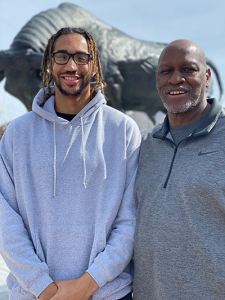
Jalen and Jimmy Moore
https://www.cachecommunityconnections.org/wp-content/uploads/ccc-logo.png00Nelda Aulthttps://www.cachecommunityconnections.org/wp-content/uploads/ccc-logo.pngNelda Ault2021-03-20 23:20:032021-03-26 13:16:26Connecting Neighbors: Jimmy Moore
Interviews Conducted by the Logan Tabernacle Concert and Lecture Series Committee of Cache Community Connections
A community’s citizens become neighbors to one another when they become aware of their mutual experiences, challenges, successes, and perspectives. Communities with low neighborhood attachment and high levels of disorganization, where many residents do not know or associate with one another and are not committed to continuing relationships, have higher rates of adult and juvenile crime and drug trafficking. Conversely, “communities that care” protect and support their citizens by developing and encouraging relationships that bridge social, cultural and economic divisions.
In 1963, Rev. Dr. Martin Luther King offered these insights:
“The good neighbor looks beyond the external accidents and discerns those inner qualities that make all men human, and therefore, brothers” (“Strength to Love,” 1963).
“We must learn to live together as brothers or perish together as fools.”
We believe that before a community’s residents can truly become neighbors, they need to know a little something about one another. Then, we can act in the true spirit of common knowledge and respect, acknowledging similarities and differences in experience and perspective, and honoring both.
“Do not waste time bothering whether you ‘love’ your neighbor; act as if you did. As soon as we do this we find one of the great secrets. When you are behaving as if you loved someone, you will presently come to love him” (C.S. Lewis, 1943).
Over the coming months, watch this page and our Facebook page for interviews and information about our Cache Valley neighbors.
Would you like to be involved in this interview project? Contact Richard West at [email protected].